
The construction industry is changing fast. Across Western Balkans and Europe, it is facing a growing demand for workers, new technologies, and increasing pressure to become greener and more sustainable. But while so many things are evolving, one thing has remained largely the same: who gets to be part of this industry. The simple answer is men.
Walk onto most construction sites today, and the picture is very familiar. Men dominate nearly every role, particularly in on-site and technical positions, while women remain far less visible and are often concentrated in different, usually non-site-based roles. This is not just a perception. Evidence from the WEC research on labour shortages and gender imbalances in the construction industry across the Western Balkans confirms a significant gap in participation, showing that women make up only a small share of the workforce and are rarely present in core technical and trade roles.
For a long time, the focus has been on how to bring more women into construction. But through the Women Empowered in Construction initiative, a different question is being asked. Instead of asking why women are not entering the sector, the focus shifts to understanding how the sector itself is organised in ways that make it harder for girls and women to enter, stay, and progress.
A new curriculum to reconstruct the construction industry mindset
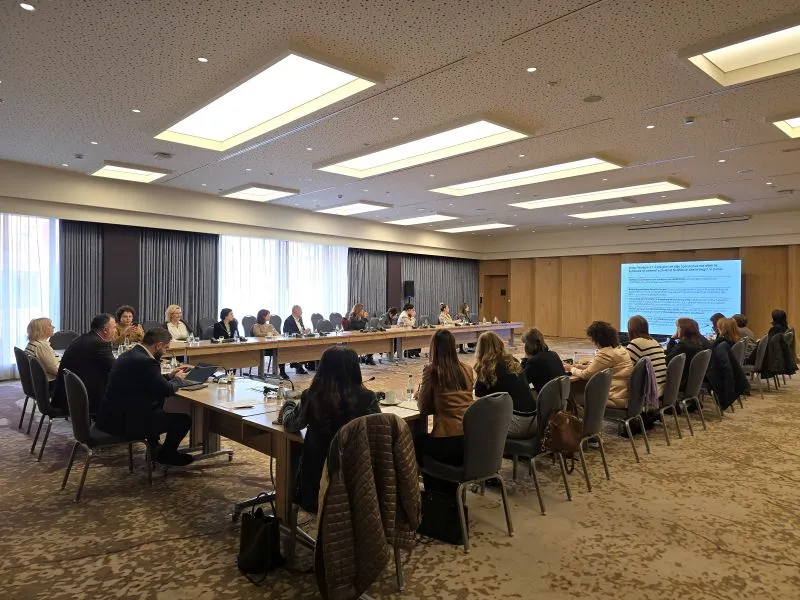
CRCA Albania team of experts are leading the work to finalise the new learning curricula: Promoting Gender Equality, Professional Competence and Entrepreneurship for Women in the Construction Sector – which contains four main modules. The curriculum is designed to equip learners with the knowledge, practical skills, and critical awareness needed to promote gender equality and inclusive workplace culture in the construction sector, while systematically addressing the structural barriers, stereotypes, and institutional practices that limit women’s participation, retention, and progression in the industry.
At the first module, one of the first moments in the training curricula is surprisingly simple. Participants are asked what comes to mind when they hear the words “construction worker.” Most people imagine a man on a building site, wearing a helmet and doing heavy physical work. That image is not an accident. It reflects how deeply gender roles are built into the way we think about construction as a profession.
The curriculum builds on this by showing that inequality in construction is not about ability but rather providing opportunities. It is about systems. It is about how training is designed, how jobs are offered, how teams work, how workplaces are organised, the role of technology in construction and how all can facilitate a transition into more inclusive industry. When you start looking at it this way, the issue becomes clearer and, importantly, more solvable.
The Barriers we don’t see
Many of the barriers’ girls and women face are not obvious at first. They are not always about skills or qualifications. They are often about mindset and of course everyday conditions. For example, a woman may leave a job in a construction site not because she cannot do it, but because there is no proper changing space for her. Equipment might not fit her properly. Opportunities might be shared informally; through networks she is not part of. She might be given support tasks instead of technical ones, limiting her experience and future progression.
What becomes clear through the training is that when the same obstacles appear repeatedly, they are not individual problems. They become structural issues that need to be addressed. And if something is structural, it means it can be changed.
From “Fitting In” to reconstructing the system: change is possible
As in any industry, the construction one evolves with time. New knowledge and technology bring new advancements, and people are at the core of such transformation. The advancements lead to an important shift in thinking. Instead of expecting women to adapt to construction as it is, the focus turns to how the sector itself needs to evolve. This is where gender sensitivity becomes practical, not theoretical. It should start by asking very simple but important questions. Are workplaces designed for everyone? Are people treated with respect? Are opportunities shared fairly? Are safety standards truly inclusive? How about personal safety?
Culture matters more than policies
A key lesson from the curriculum is that change does not happen only through policies. You can have rules in place, but what really shapes people’s experience is the culture on site. It is in everyday interactions, in who is listened to, in how mistakes are treated, and in whether people feel included or isolated. In many cases, exclusion is not intentional. Views and perceptions about women’s role in most of the so-called “old” or traditional industries were not as inclusive and open as they are now. The development of society itself led to a better understanding of human rights, equality, division of labour, gender roles, and overall women’s role in society.
What once was seen as normal behaviour today is not. This is also because, over time, the patterns of exclusion had real consequences. They affect who stays, who leaves, and who advances in employment opportunities.
That is why the planned training do not stop at awareness. They focus on building practical skills. Participants will learn how to recognise unfair situations, understand their rights, communicate clearly, and work effectively in diverse teams. They also learn that change does not always require big actions. Sometimes it starts with noticing something that was previously ignored or speaking up in a way that feels safe and constructive.
Learning to see, speak, and act
This matters not only for individuals, but for the future of the industry. The construction industry, as we have mentioned in this article, needs to reconstruct itself. It needs more people, more skills, more technology, better tools and new perspectives. Workplaces remain difficult or unwelcoming for a part of the population, the sector risks losing valuable talent.
Gender equality, in this context, is not just about fairness. It is about making sure the industry can adapt and grow. It is about creating environments where people can contribute fully and stay in the profession. Changing the face of construction will not happen overnight. But it starts with small, practical shifts. It starts with seeing things differently, questioning what has always been accepted, and creating space for change.
The way forward
At its core, the WEC curriculum is about more than training, it is about opening and shaping the construction sector. Across its modules, from understanding gender equality and workplace culture, to building professional skills, strengthening entrepreneurship, and supporting pathways into employment, the aim is to prepare individuals who are not only technically capable, but also aware, confident, and ready to contribute to more inclusive and sustainable workplaces. By the end of the learning journey, the expectation is simple but powerful: that participants leave not just with new knowledge, but with the ability to see the sector differently, navigate it more confidently, and play an active role in changing it for the better.
Construction is not only about buildings and infrastructure. It is about people. The future of the sector depends very much on who can be part of it, and under what conditions. It’s time for the construction industry to reconstruct itself with girls and women on it.

Funded by the European Union. Views and opinions expressed are however those of the author(s) only and do not necessarily reflect those of the European Union or the European Education and Culture Executive Agency (EACEA). Neither the European Union nor EACEA can be held responsible for them.