Women make up only 8–14% of the construction workforce across most European countries — a figure that drops even lower in site-based technical roles. This is not a coincidence, nor is it the result of lack of interest or ability. It is the product of deep structural barriers that have shaped the industry for generations.
Three Levels of Barrier
Researchers distinguish between three interconnected levels of barrier to gender equality. At the individual level, girls and young women often lack visible role models in the trades, reducing their sense of belonging before they even apply for training or work. At the social-norms level, pervasive assumptions about ‘men’s work’ and ‘women’s work’ shape occupational choices long before any employer makes a hiring decision. At the institutional level, recruitment networks, site facilities, ill-fitting personal protective equipment (PPE), and informal hiring practices all reinforce exclusion — even when no individual intends to discriminate.
Formal vs. Substantive Equality
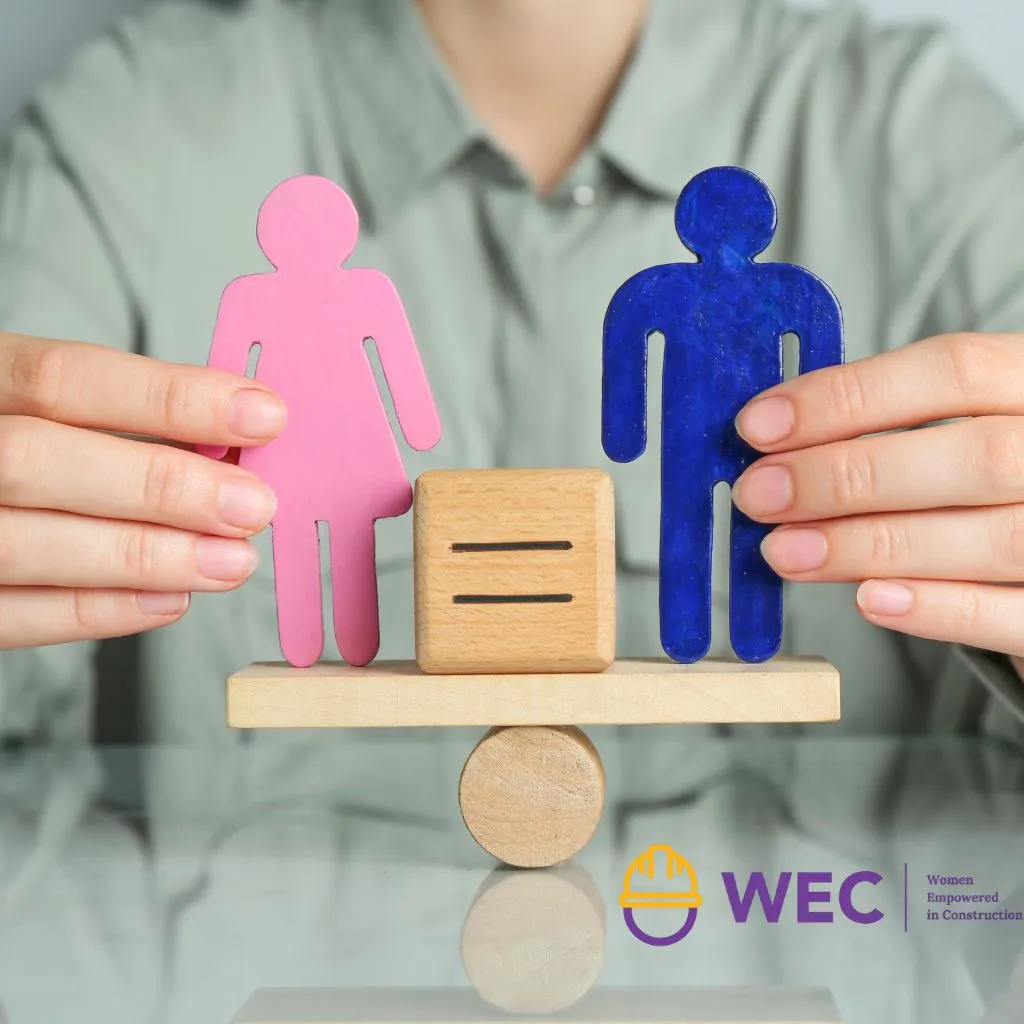
A critical distinction for anyone working in or advocating for gender equality is the difference between formal and substantive equality. Formal equality means that anti-discrimination laws exist and apply equally to all. Substantive equality means that access, retention, progression, and safety are genuinely equal in practice. A woman hired and then forced to leave because there is no changing facility, or because her protective equipment does not fit, demonstrates that formal rules and lived reality can diverge sharply. Closing this gap is the core challenge of gender equality work in construction.
Why It Matters for the Whole Industry
The construction sector faces serious and well-documented skills shortages across Europe. Expanding the talent pool is not only an equity imperative — it is an economic necessity. Research consistently shows that diverse teams make better decisions, produce fewer errors, and are more innovative. A sector that excludes roughly half the population from many of its roles is limiting its own potential. Recognising gender inequality as a systemic problem, rather than an individual failing, is the essential first step toward building a more sustainable, resilient, and inclusive industry for everyone.
What Structural Change Looks Like
Structural change requires action at all three levels simultaneously. At the individual level, it means mentoring programmes, visibility campaigns, and outreach to schools. At the norms level, it means confronting assumptions in team culture, language, and media representation. At the institutional level, it means revising recruitment criteria, auditing pay structures, redesigning welfare facilities, and ensuring that PPE is available in sizes that fit all workers. No single intervention is sufficient — genuine change requires sustained effort across all these dimensions.

Funded by the European Union. Views and opinions expressed are however those of the author(s) only and do not necessarily reflect those of the European Union or the European Education and Culture Executive Agency (EACEA). Neither the European Union nor EACEA can be held responsible for them.