Country Findings from the WEC Research: Montenegro
Introduction
The Women Empowered in Construction (WEC) project aims to strengthen women’s participation in vocational education and training (VET) and employment in the construction sector. As part of the project’s research phase, partners collected country-level insights to better understand the current situation, main barriers, and opportunities for attracting and supporting girls and women in construction-related education and careers. This article presents key findings from Montenegro.
Current context: women and construction in Montenegro
Construction remains a traditionally male-dominated field in Montenegro. While the sector offers stable employment opportunities and diverse career paths (from technical design and planning to on-site work and management), girls are still underrepresented in construction-related VET programmes and later in the labour market. Social perceptions about “men’s jobs” and “women’s jobs” continue to shape educational choices, especially during early secondary school years.
What influences girls’ choices: perceptions and role models
A major finding from the research is that girls’ interest in construction is strongly influenced by how the profession is presented and by the presence (or absence) of relatable role models. Many students still associate construction mostly with heavy physical work, outdoor conditions, and predominantly male workplaces. When students are exposed to modern construction technologies, design-oriented tasks, sustainable building approaches, and digital tools, their perception shifts and interest increases.
Role models—female engineers, architects, site managers, or skilled workers—have a particularly strong impact. Seeing women successfully working in the field helps girls imagine themselves in similar roles.
Key barriers identified
The research highlighted several barriers that limit the participation of girls and women in construction-related education and employment:
- Persistent stereotypes and social expectations: Families and communities often encourage girls to choose “safer” or “more suitable” professions.
- Limited visibility of career pathways: Students are not always aware of the wide range of construction occupations and progression routes.
- Workplace culture and confidence gaps: Some girls anticipate uncomfortable environments or lack confidence entering male-dominated settings.
- Insufficient practical exposure: When students have few opportunities for site visits, hands-on workshops, or mentorship, construction remains abstract and less attractive.
What supports participation: practical learning and partnerships
One of the strongest supportive factors is meaningful, well-structured practical learning. Practical training that is planned, supervised, and connected to real tasks can increase students’ confidence and motivation. Partnerships with local companies also matter: they enable work-based learning, mentoring, equipment support, and real-life examples of professional standards.
When employers actively welcome female students, provide safe and respectful training environments, and present clear pathways for internships and employment, girls are more likely to see construction as a realistic and promising option.
Opportunities for improvement (what the research suggests)
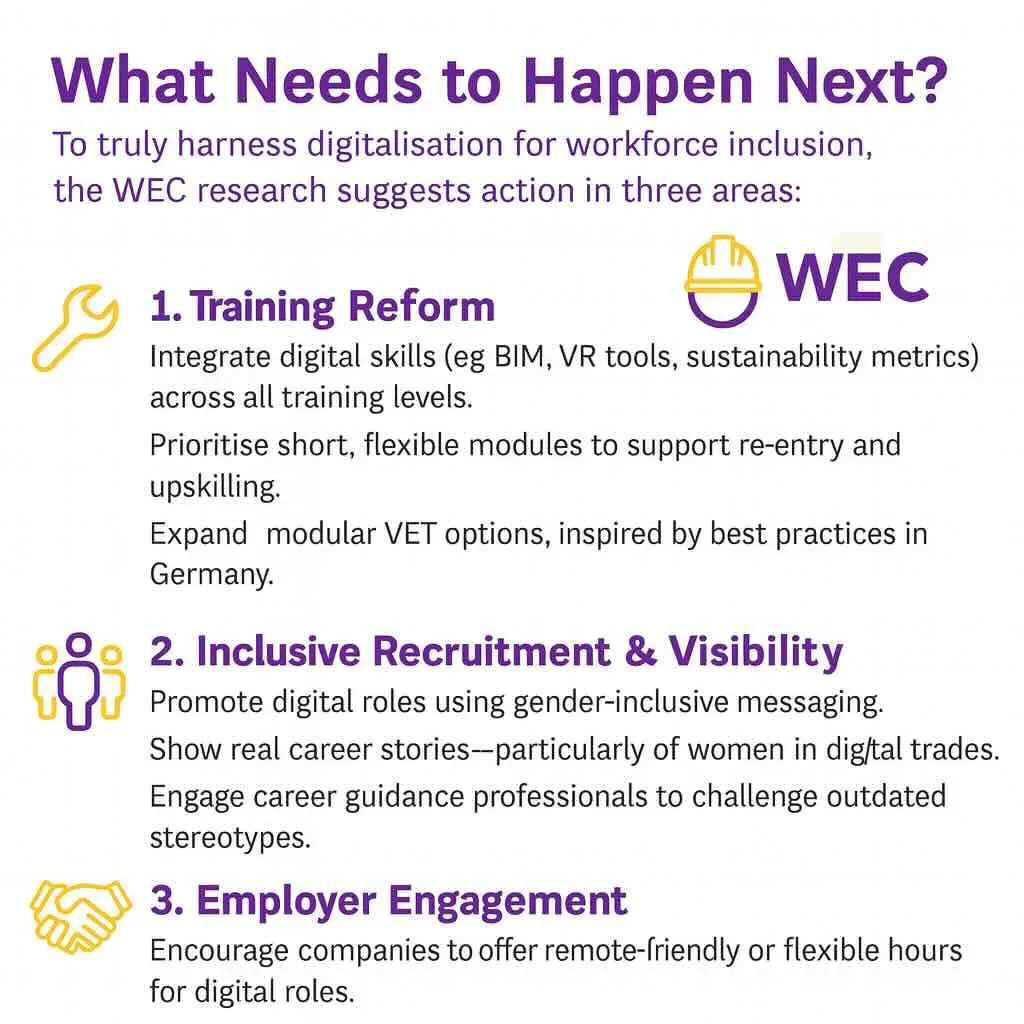
Based on the findings, several actions can significantly improve participation and retention:
- Better career guidance in schools with clear information about occupations, salaries, and progression routes.
- Promoting modern construction (digital tools, BIM, sustainable materials, interior finishing, dry construction systems, project planning).
- Mentoring and role-model activities, including guest lectures and “Women in Construction” talks.
- Stronger school–industry cooperation through site visits, internships, and joint events.
- Visible communication campaigns that show girls and women in practical and technical roles—not only in supportive positions.
Conclusion
The research in Montenegro confirms that increasing women’s participation in construction requires both cultural and practical changes: challenging stereotypes, improving visibility of career opportunities, and providing supportive learning and workplace environments. Through WEC, partners in Montenegro will use these findings to strengthen VET content, improve outreach and guidance, and build stronger bridges between schools and the construction industry—so that more girls can confidently choose and succeed in construction careers.